
What the fleece?!
Microplastic pollution, wool pile fleeces, and so much complexity in the cloth.


Hello, good people of TOGS. North again.
This week we’re talking about wool-based fleeces, but first we’ve got to go on a bit of an educational romp to get there :)
Back in November, I took a trip down to Portland, Oregon, to cruise the Functional Fabric Fair, a trade show where textile mills, trims suppliers, and other people of the cloth hawk their wares to designers who make performance clothing, bags, and footwear.
In some ways, it was a bit like visiting Build-A-Bear Workshop, but for gear. Here were your insulations and your laminated fabrics, your wools, your elastics, and your zippers: choose your components and make your dreams come true! was the vibe. (Of course, it’s a bit more complicated than that.)
Among the more common ingredients on offer, I also discovered ones that I didn’t know existed, such as fish leather, fabric made from roots woven with computer guidance, and so many types of fabric coatings.
As I walked by one booth, a man waved me down and handed me a flyer. I opened it and saw this:
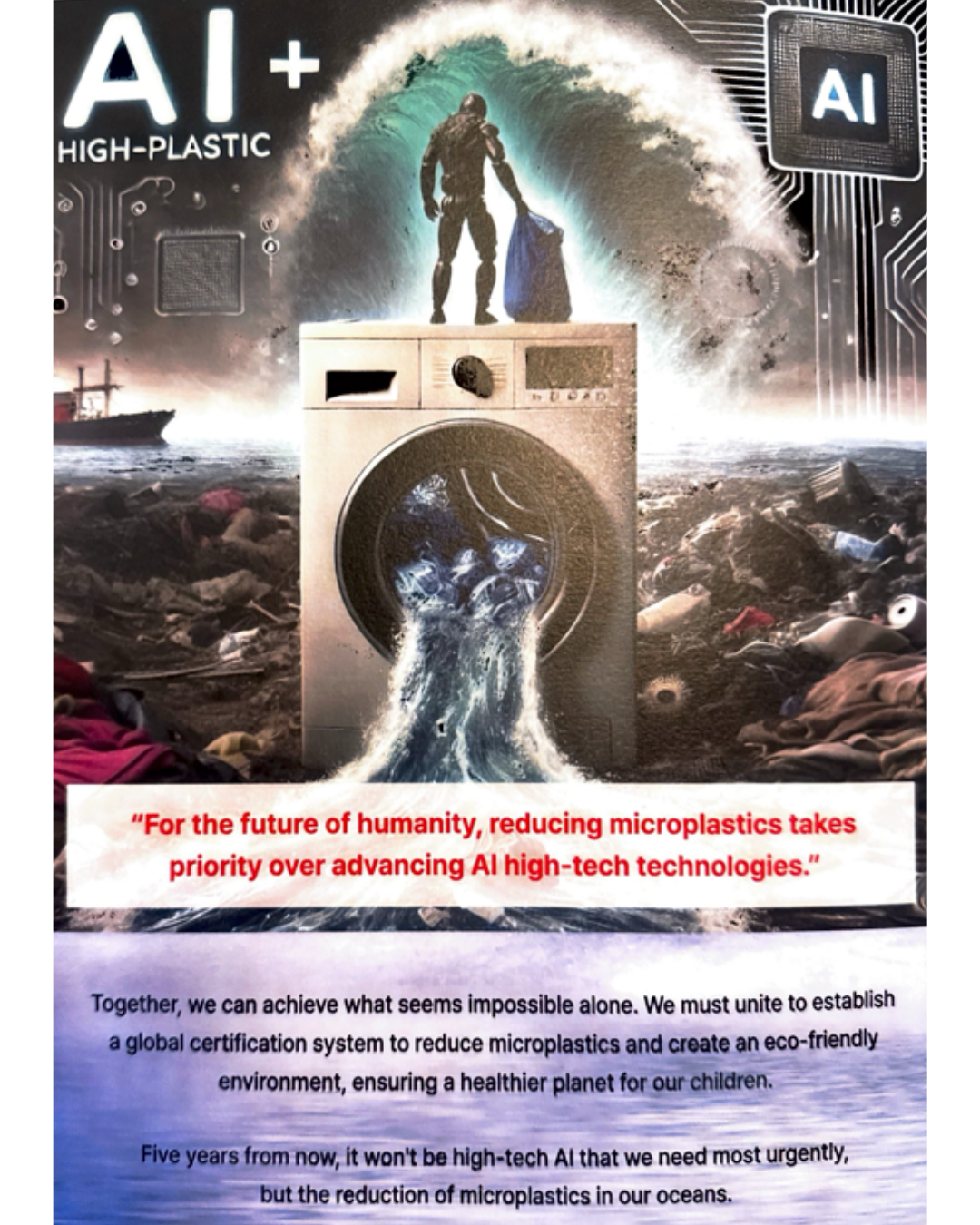
Weird issues to compare? For sure. But intriguing for its framing? Definitely. I asked the man how his product would solve this issue. He said that his company, Dongin Textile, which is based in Korea, made a single-sided DWR-finish that reduced microplastic shedding in the washing machine. We struggled through a mutual language barrier, but in the end I understood that the coating helped keep little fibers from falling off clothes and getting swept out to sea.
I thanked him and walked away, wondering how the stakes of this issue measured up against the hyperbole of his delivery. It turns out that he was pointing to a legitimate concern. Microplastics—a term that refers to any piece of plastic less than 5mm in length—have been found pretty much everywhere, from the far depths of the ocean to the insides of brains like yours, reading this. Not only can they be dangerous in and of themselves, but they also serve as a vehicle upon which other harmful chemicals can hitch a ride. Since researchers have only recently begun studying this type of pollution, its effects are still being understood. But what we do know is that microplastics are here (*gestures all over*) and that their concentrations are growing.

A Fuzzy Problem
Where are the microplastics coming from? Textiles, mostly, at least in the oceans. Scientists estimate that textiles produce 35% of oceanic microplastic pollution, with laundering serving as a main source of shed (hence the single-sided DWR). According to the New York Times, this makes textiles the largest known source of marine microplastic pollution, accounting, as they do, for 2.2 million tons of microfibers flowing into the ocean every year. (Maybe your smelly friend actually just loves water quality and aquatic critters!)
In the outdoor industry, attention to this issue has centered on fleece, whose lofted fibers just look so shed-able. In 2015, Patagonia—the brand that brought acrylic pile fabric to the outdoors in the early ‘70s— funded a much-cited study to better understand just how much material fleece loses in the washing machine.
Conducted by grad students at University of California, Santa Barbara, and published in Environmental Science & Technology, the study found that fleeces can and do lose a ton of fibers in the laundry— up to 250,000 of them per garment, per cycle. However, the quantity of fibers shed depends on a whole host of factors, including the age and quality of the fleece, the fabric finishings present, and the type of washing machine involved. To add to the muddle, the study also included a nylon shell jacket, which, surprisingly, shed a similar amount of—and in some cases more—fibers as the fleeces did.
Now, what are we to make of all that? This Outside piece from 2024 does a good job of situating and qualifying the study’s findings, but the TL;DR is that the blame is distributed across synthetic fabric types, the extent and cause of the problem are hard to measure, more research is needed, and, ultimately, that mitigating solutions will need to come at every level of the supply chain, from manufacturing to washing (a number of microfiber filters already exist, but with limited efficacy) to disposal/recycling.
That’s the science side of the issue. On the regular-person side, we have still have a broad perception that synthetic fleece—a key fabric in the pantheon of GORP!— is the worst actor when it comes microfiber pollution. And while that’s not the full story, it’s still an impactful one: a story that’s worth editing toward a better ending.
Fleece, minus the microplastic pollution
If the problem is that synthetics fibers shed from your fleece, flow out into the world, and fail to biodegrade, then the obvious solution is to wear fleeces made of natural fibers that break down on a reasonable time scale. If only it were that simple.
Katie Okamoto reports in the Wirecutter that “even textiles labeled ‘100% natural’ can contain up to 30% chemical additive by weight, often applied for stain resistance, water repellency, fire retardancy, and antimicrobial properties.” These chemicals can prolong the lifetime of natural fibers in the environment—they keep them from biodegrading—thereby making them act more like plastic as pollutants. So: in addition to being aware of fabric content, it pays to consider fabric coating, too.
I went looking around for pile fleeces designed with all of these considerations in mind, and really, only one offering fit the bill: the Woolaroo Collection from Outerknown, the clothing brand founded by surf legend Kelly Slater and designer John Moore in 2015. (That a surfer would bring a fleece jacket made with biodegradable wool fabric to the market only feels right!)
The Woolaroo Collection is made with a MWool, a 100% wool fabric produced by the Italian textile company Manteco. The pile texture is created via a mechanical raising process that lifts the wool fibers to form a dense heat-trapping loft that has the appearance of sherpa fleece. According to Manteco, this construction is warmer and more breathable than felted or compact knit fabrics. Speaking from personal experience, mine has been toasty as heck. If you’ve seen me since the cold returned this winter, I’ve likely been wearing it.

It’s worth acknowledging the roundabout irony of making a wool pile fleece. The first synthetic fleece jackets were designed as functional alternatives to wool sweaters, which were slow to dry, heavy when wet, and difficult to clean. A wool fleece like the Woolaroo leverages the insulation benefits of the pile texture, but also retains some of the drawbacks of wool in general. (Outerknown recommends dry cleaning the Woolaroo, for example.)
All that, and the end material looks remarkably sheep-like (in a good way, I think)—a natural effect that’s apparently quite difficult to pull off naturally!
Ok, but what about fleeces made with blended materials?
The muddled world of microplastic pollution aside, there are a number of solid reasons to wear wool-based fleece, even when it has synthetic components. Here are three salient ones:
1. They can divert wool fabric scraps from the landfill.
Raising sheep and producing wool is a resource-intensive process, which makes it all the worse when scraps end up on the cutting room floor. A number of brands are recycling factory remnants and post-consumer garments into new clothes. Patagonia has a solid collection of sweaters, fleeces, and hats made this way, and I particularly like this vest from Snow Peak, which is made from RE:NEWOOL®, a recycled wool-based material produced in Japan. From my experience, these wool blends feel less slippery/plasticky than 100% synthetic fleeces, and the pile often has a wilder, more interesting visual texture.

2. They resist getting irredeemably stinky.
Synthetic materials are notorious for succumbing to a stench that won’t quit, but research suggests that blended fabrics with 30% or more wool content resist smells as well as those made with 100% merino wool. All the while, the synthetic components can improve certain qualities, such as durability and stretch.
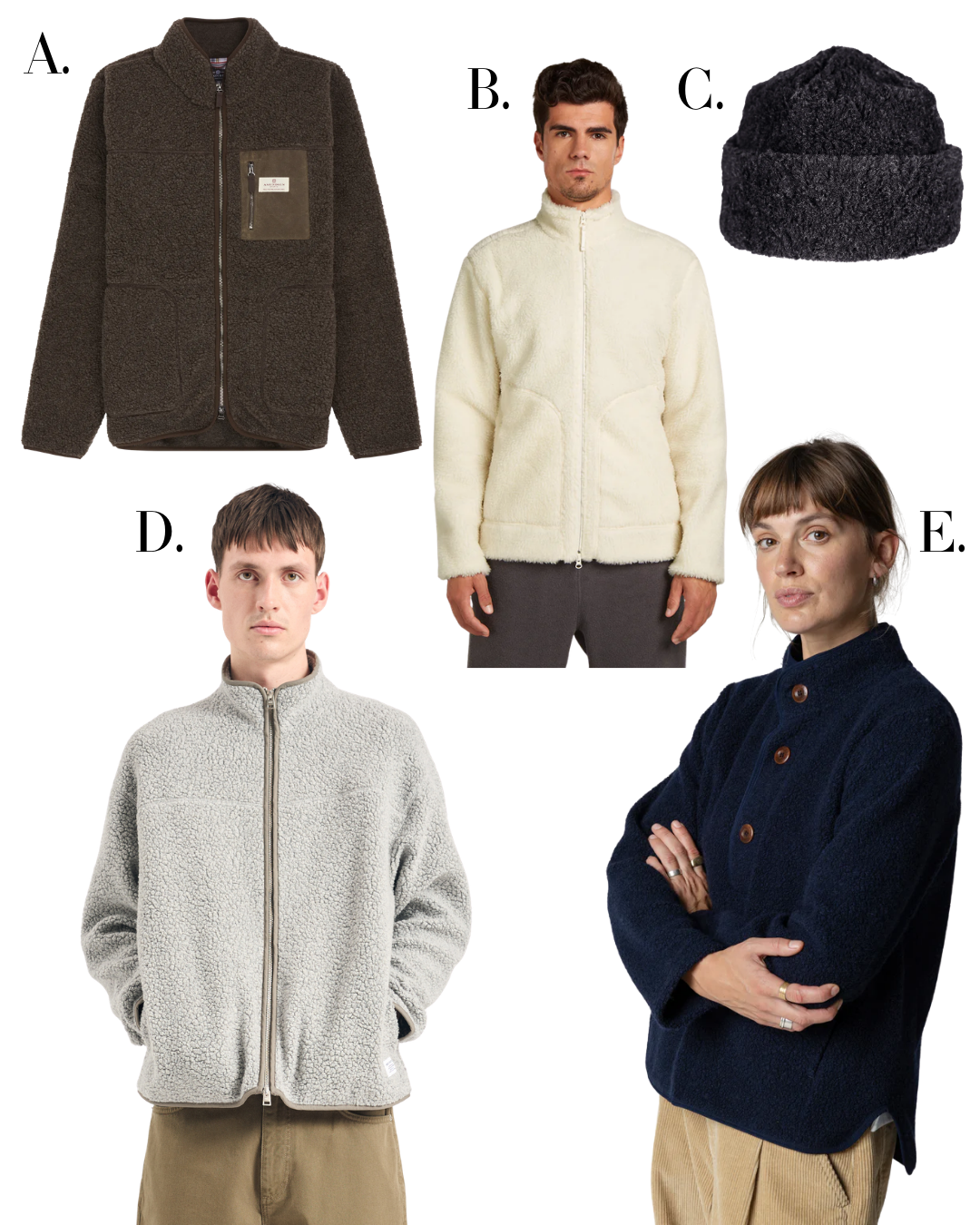
A. Amundsen Heroes Wool Fleece Jacket (Women | Men) - 55% wool, 45% polyester
B. Icebreaker Merino Blend 960 RealFleece™ High Pile Long Sleeve Zip Jacket (Women | Men) - 100% merino wool face fabric / 100% TENCEL™ Lyocell main body back / 85% TENCEL™ Lyocell, 15% merino wool lining
C. Rustek SherpTek V2 100% Merino Wool ‘Sherpa’ Beanie - 100% merino wool fleece and lining. NB, this hat is super warm and—per military spec—non-melting. Plus, it’s got a fun silhouette!
D. Norse Projects Bjorn Sherpa Wool Fleece Jacket - 57% wool, 22% polyamide, 16% polyester, 5% other fibers
E. Finisterre Elowen Fleece Sweater - 48% recycled wool, 44% recycled polyester, 4% polyamide, 4% other fibers main body fabric / 100% organic cotton lining
3. They can offer some nice performance benefits.
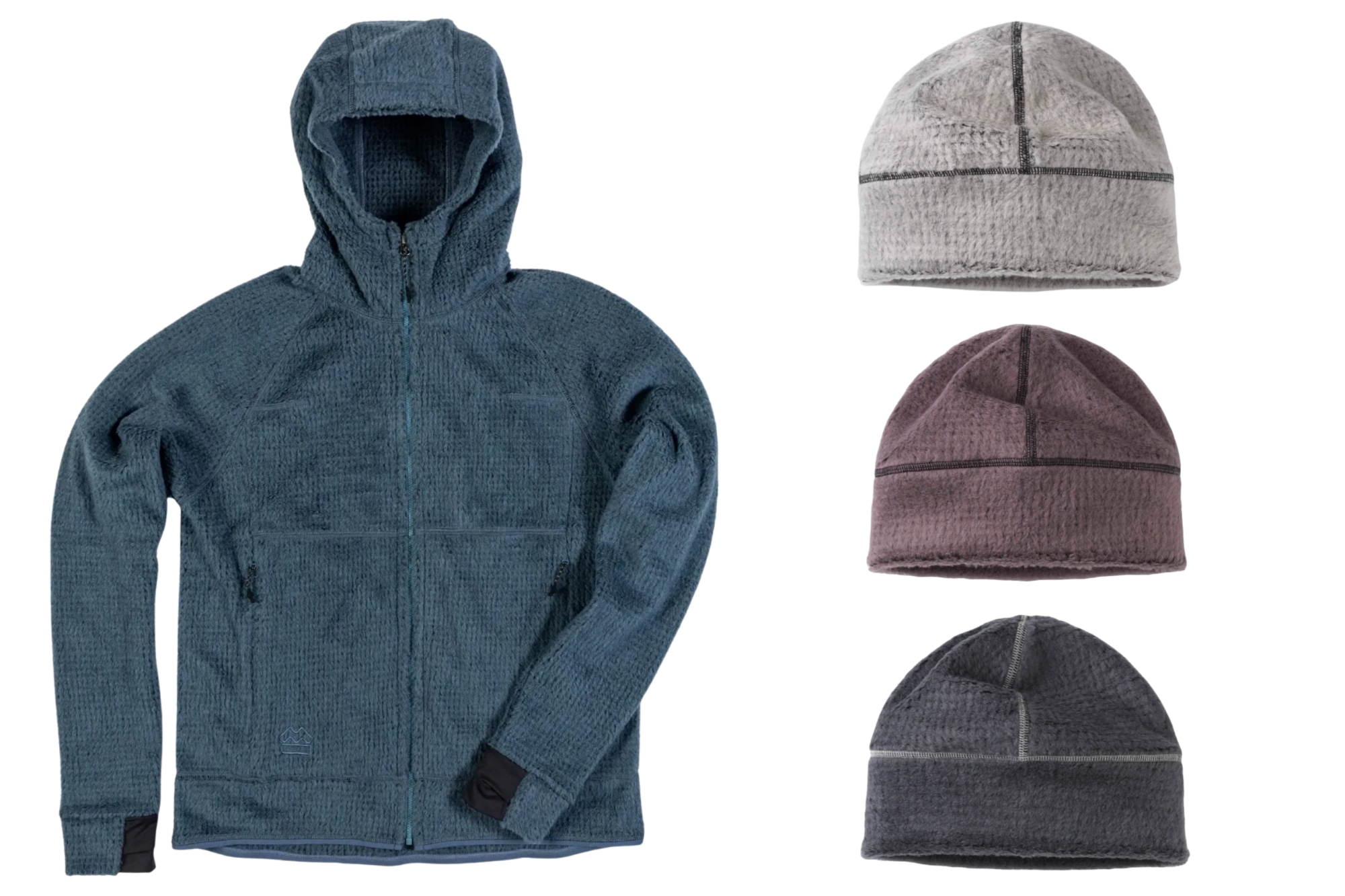
High-quality wool is often more comfortable and better at regulating temperature across a wider range of conditions than synthetic materials. Fabrics like Polartec High Loft™ make the most of these performance benefits while maintaining important qualities like durability and shape retention. The pile of High Loft™ fabric is made from a very fine merino wool that’s wrapped around a hollow nylon core, which ensures that only wool touches your body. Those yarns are then anchored in an open-knit polyester, giving the fabric its form. The result is something light, compressible, and super warm for its weight.
Thinking back to the pamphlet I got at the Functional Fabric Fair—is that where we’re headed? A wasteland world where washing machines discharge dirty water into oceans replete with little bits of trash? Maybe, eventually, if nothing significant changes.
When I see a piece of clothing now, I imagine not its end in a landfill, but its slow dissolution into the world: how, over years of use, it will quietly shed fibers and their chemical coatings across the living earth. Over centuries, those bits will abide in our soils and seas like little plastic ghosts, seeds planted to sow a synthetic future. It’s a grim vision, sure, but also one that makes an invisible problem visible: otherwise, it’s too tiny and subtle to regularly see.
Will we let future pastures continue to grow plastic?
Baa, I hope not.
Sending warm fuzzies (the good kind),
North 🐑 🐑 🐑
Off the Grid
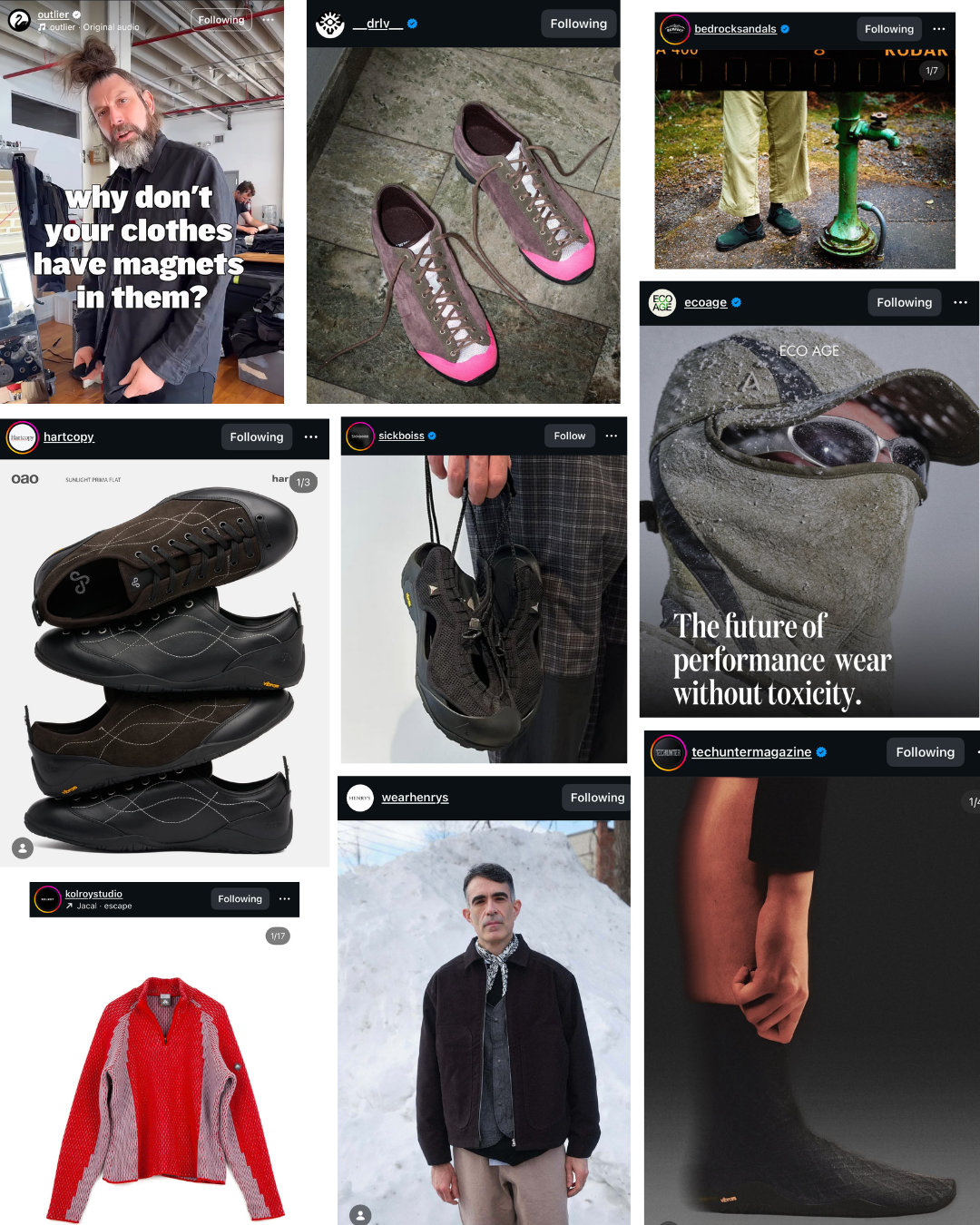
It appears that my algorithm hasn’t moved on from footwear inspired by approach shoes.
👏🏻 Amazing read, North. I’ll be much more intentional next time I shop for a fleece. Thanks for the info.
Brilliant piece. The research is potent + well discussed. Let us know next time you hit up FFF would love to hang! Wool blend fleeces are so hard to find, but think they one of the most impactful ways to shift the effect of our innately harmful industry. Every fleece we have launched at our lil outdoor brand has a wool element and will forever keep it that way. Appreciate this piece to know we aren’t alone in this one!!